
Smart City Starts With Operations
Smart city is still too often described from the outside in
The phrase smart city still tends to arrive wrapped in familiar imagery: dashboards, control rooms, cameras, connected devices, and the assumption that once enough signals are collected, the city will become more intelligent by default.
That is rarely how it works.
Cities do not become meaningfully smarter simply by adding one more interface layer. They become more effective when they can detect operational problems earlier, understand them faster, and coordinate responses across institutions that would otherwise act in parallel.
That distinction matters. Many city programs still invest in visibility before they solve for operations.
Road safety is one of the clearest areas where this gap is evident. At first glance, it looks like a narrow use case. In practice, it exposes the whole operating model.
When a city cannot quickly identify accidents, localize them precisely, add context, route them to the right teams, and follow the incident through to resolution, the problem is not only traffic. It is fragmentation.
The same weakness appears again and again:
- a huge volume of video streams from cameras
- manual monitoring
- lack of centralized analytics
- weak data integration between cities or agencies
- limited traffic analytics
- slow evidence processing
- limited ability to predict traffic jams and accidents
These are not isolated technical inconveniences. They show that the operating system underneath the city is still too thin.
The useful unit in smart city is not the dashboard. It is the scenario.
The real starting point is not the interface. It is the operating scenario.
Traffic accidents, suspicious activity, crowd build-up, fire and smoke events, road damage, utility anomalies, disruptions in public spaces: these are the moments that show whether a platform is useful or cosmetic.
A serious city platform has to be built around such scenarios from the start. It has to support detection, context, escalation, and coordinated action, not just monitoring.
That requires not one feature, but a layered operating model.
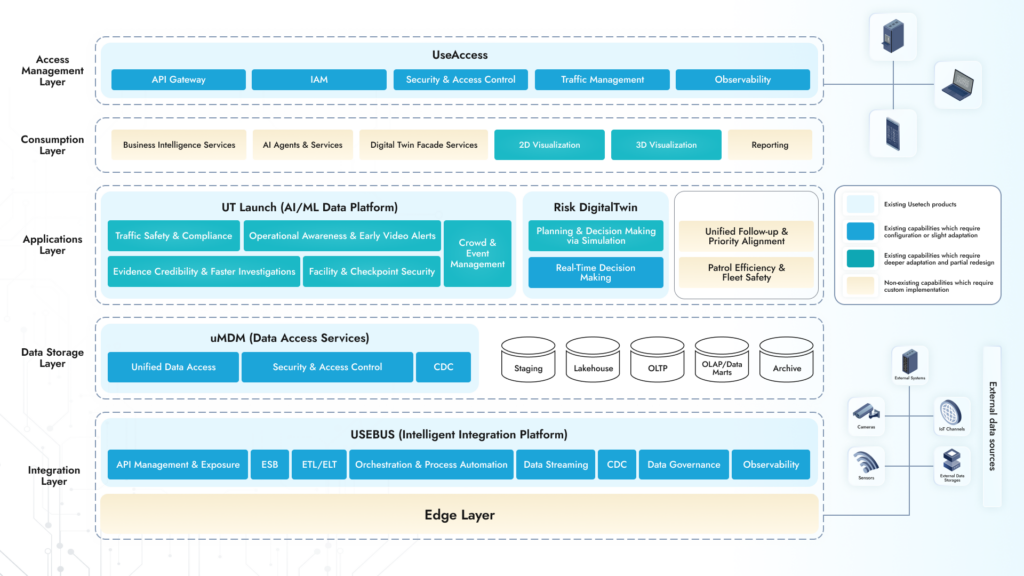
Platform concept: an integrated smart city ecosystem built to connect monitoring, analysis, workflows, and response across public operations.
At a high level, that model begins with perception and integration. A city already produces enormous volumes of data through CCTV, sensors, smart devices, control systems, and service applications. But raw visibility does not create operational value on its own.
The system has to turn those signals into a live operating picture. It has to correlate them, interpret them, and help teams act.
What a workable smart city platform does, step by step
The clearest way to read the platform logic is as an operating sequence.
1. Build a city-wide operational view
Before a city can respond well, it has to see enough of the environment in one place.
That means a real-time data overlay from multiple integrated sources, not a collection of disconnected monitoring windows. It means city-wide visibility across locations, services, and incident points, so teams are not forced to reconstruct the picture manually every time pressure rises.
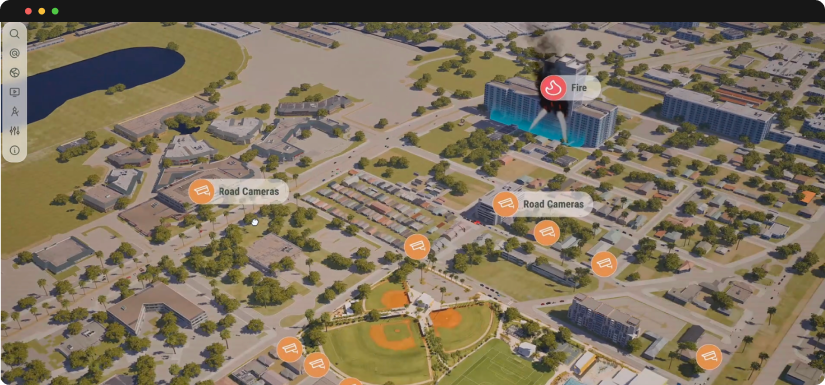
Launch screenshot: a city-wide operational view with real-time overlays from integrated urban systems.
2. Add a decision layer, not only a display layer
Once the operating picture exists, people still need to work with it quickly.
This is where natural-language interaction becomes more than a fashionable interface choice. If operators can query real-time traffic conditions, incidents, and trends in plain language, they move faster. They do not waste time moving through layers of menus when what matters is context, clarity, and speed.
The value here is practical: faster decision-making with contextual, data-driven answers across integrated systems.
3. Detect and localize incidents in real time
Detection is where smart city starts to become operational rather than observational.
A useful platform does not wait for manual review. It automatically identifies incidents from live data streams, alerts the right teams, pinpoints location, and attaches contextual details such as time, severity, and visual evidence.
This matters especially in road safety, where delay compounds quickly. A few lost minutes affect congestion, secondary risk, emergency access, and public trust at the same time.
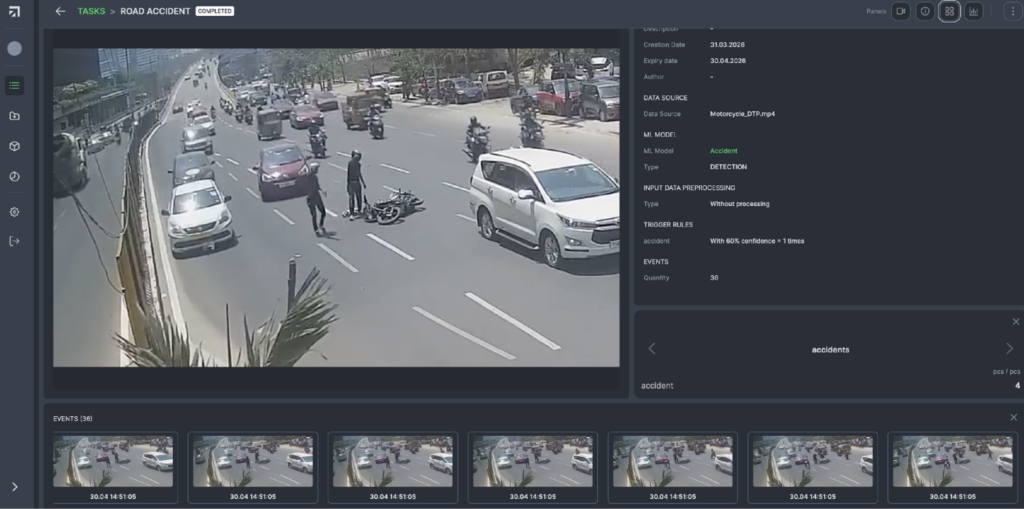
Launch screenshot: AI-powered video analytics with incident detection, evidence capture, and contextual controls.
At this stage, AI-powered video analytics becomes valuable not because it looks advanced, but because it reduces manual review, improves inspection accuracy, and turns the camera layer into an operational layer.
4. Orchestrate response across services
Detection alone is never the finish line.
The harder question is always what happens after the alert.
Which team is notified first? Which service takes the lead? How is evidence packaged? How is the incident tracked? How does escalation work? How do traffic operations, public safety, emergency response, and infrastructure teams coordinate without creating another layer of confusion?
That is why end-to-end incident management matters so much. A strong platform centralizes workflows in a single environment and supports predictive simulation of incident evolution, so resource deployment and containment are not left to fragmented judgment calls.
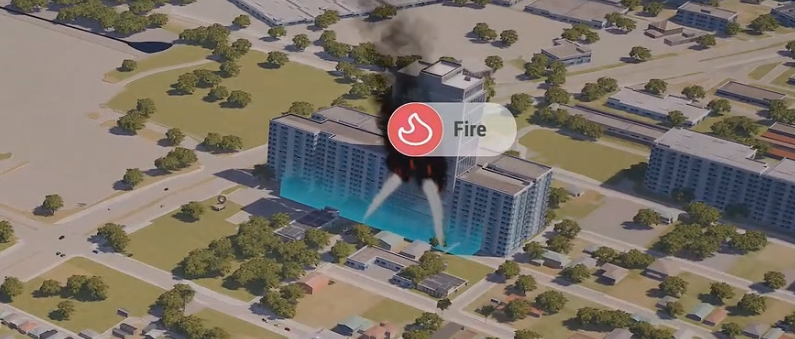
Launch screenshot: end-to-end incident management with predictive simulation to guide resource deployment and containment.
This is also the point where digital twin logic becomes genuinely useful. Not as a visual effect, but as a way to understand how a situation may evolve before the cost of delay becomes higher.
5. Unify control, measurement, and learning
The final stage is not a prettier dashboard. It is a shared control layer.
Cities need an aggregated view of key data across multiple services and systems. They need cross-domain visibility that supports coordinated monitoring, faster response, and better post-incident review. They also need a way to measure whether the operating model is actually improving.
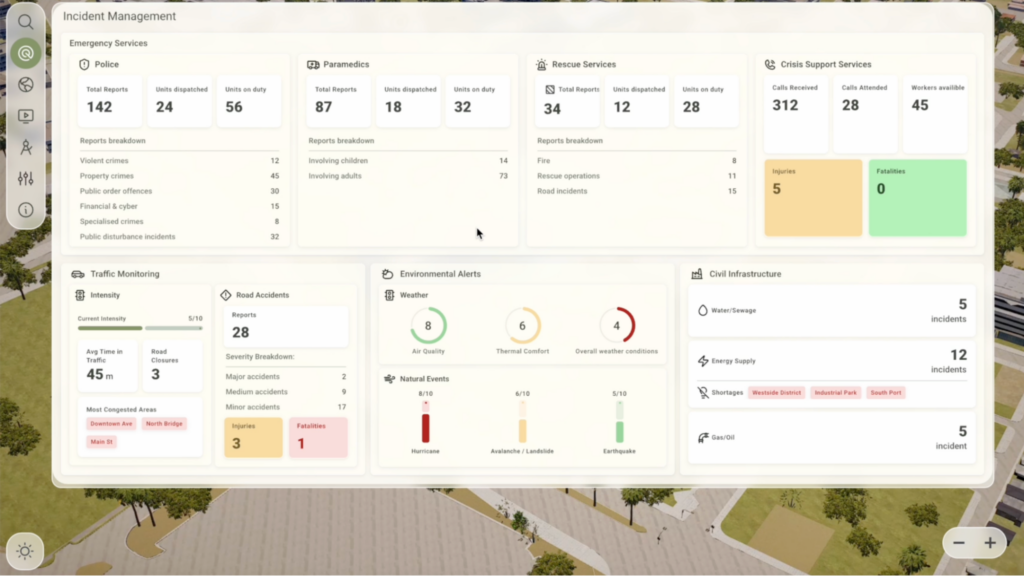
Launch screenshot: a unified city operations dashboard aggregating response, risk, and performance signals across services.
This is what allows the platform to move from isolated response toward continuous operational improvement.
The application set is broader than traffic
Road safety is often the most visible starting point, but the same platform logic extends naturally into other city scenarios:
- traffic accident detection with contextual visualization and coordinated response support
- crime incident detection and situational analysis
- fire and smoke detection with propagation modeling
- crowd monitoring and large-scale event management
- infrastructure anomaly detection, such as road damage or utility failures
That breadth matters because it changes the commercial and institutional logic of smart city.
The goal is no longer to buy a collection of point solutions for separate departments. The goal is to create a connected operations environment in which a single incident can move through detection, analysis, response, and follow-up without breaking down at every institutional handoff.
Why is this conversation becoming more practical in MENA
Across the Gulf, the smart city conversation is slowly becoming less theatrical and more operational. That is a healthy shift.
The country logic is different, but the direction is similar:
- In the UAE, the public sector signal is moving toward integrated digital services, trusted AI, and infrastructure that must work as a single, coordinated environment rather than as separate modernization projects.
- In Saudi Arabia, large-scale public operations already make the stakes visible. High-volume mobility, pilgrimage logistics, safety, and service coordination show what happens when the question is no longer whether technology is present, but whether it can support execution under real pressure.
- In Oman, the opportunity looks especially practical. The local signal is less about futuristic language and more about public operations, mobility, monitoring, utilities, and connected infrastructure.
- In Qatar, the pattern is more governance-led, but the implication is similar. Digital transformation is increasingly being treated as institutional infrastructure, which raises the importance of interoperability, control, and trusted operating environments.
Our existing regional source base points in the same direction beyond policy statements alone. It includes work on digital twin logic in Oman’s logistics infrastructure, Gulf commentary on digital twin adoption, and broader materials on how public and quasi-public systems are moving from isolated digital layers toward coordinated operational platforms.
That is the more useful way to read “smart city” in MENA today: not as a futuristic label, but as an operational design question.
What value should the platform be measured against
The most credible smart city metrics are operational ones.
They do not ask whether the platform looks advanced. They ask whether it improves how the city works:
- up to 30% improvement in operational efficiency across city services through unified monitoring and optimization
- 25-40% faster incident handling and response cycles enabled by automated detection and coordinated workflows
- up to 50% reduction in manual monitoring workload through AI-driven video and sensor intelligence
- stronger AI-assisted cross-domain coordination through a unified platform that connects and correlates multiple city systems
- These targets are useful because they connect directly to management realities: less time lost to escalation, less manual review, fewer blind spots, and better alignment among systems that already exist but do not yet operate together well enough.
Smart city becomes credible when it improves its response
This is the deeper shift now taking shape.
The strongest smart city platforms are not the ones that present the most futuristic visual language. They are the ones that improve inspection accuracy while maintaining flow, reduce congestion, support prevention efforts, and help institutions coordinate more quickly as conditions become more complex.
That is why the question of smart cities is becoming more serious.
It is no longer “what can the city display?”
It is “what can the city detect, understand, and resolve together?”
The real transition is not from analog cities to digital cities.
It is from fragmented urban systems to connected city operations.