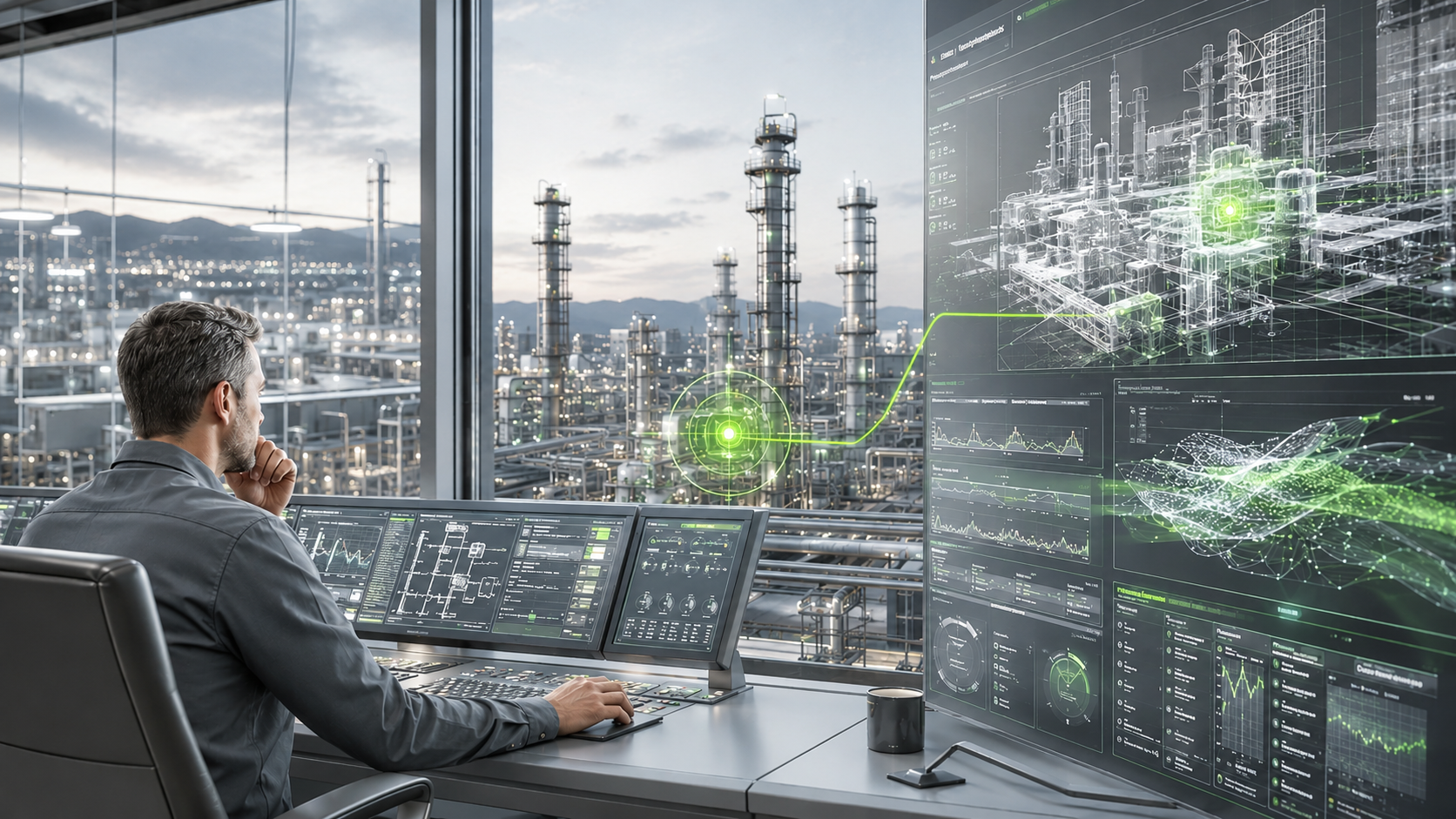
Human Operator vs. AI Monitoring: Who Detects an Industrial Incident Faster?

AI monitoring in manufacturing doesn’t replace the operator. It’s what allows the operator to make the right calls instead of sorting through thousands of alerts.
What Is AI Monitoring in Manufacturing: A Definition for Operational Environments
AI monitoring in manufacturing is the use of Machine Learning systems, Computer Vision, and automated analytics to continuously track the state of equipment, processes, and personnel in real time. Unlike traditional threshold-based monitoring — where an alert fires when a preset value is exceeded — AI systems analyze patterns, anomalies, and deviations from baseline, detecting an incident before it becomes a failure.
In the context of MENA’s industrial environments — oil and gas, energy, manufacturing, logistics — this question carries direct strategic weight. 66 out of 99 Saudi Vision 2030 goals are tied to data and AI, and industrial operational efficiency is one of the program’s key measurable outcomes. Across Saudi Arabia, the UAE, and the wider GCC, the pressure to modernize operational control is no longer aspirational — it is a delivery requirement.
Why This Question Has Become Critical Right Now
AI monitoring in manufacturing is not new. But the conversation has shifted materially in 2025–2026 for two reasons.
The first is scale. According to Gartner, IT spending across MENA will reach $169 billion in 2026 — an 8.9% year-over-year increase — with a significant share directed toward industrial automation and AI infrastructure. Monitoring systems are no longer experimental investments. They are becoming operational baseline.
The second is the nature of threats. The IBM Cost of a Data Breach Report 2025 identifies the leading causes of incidents in the Middle East as third-party and supply chain compromise (17% of cases), phishing (14%), and malicious insider threats (11% — with the highest average incident cost). In this environment, detection speed defines the difference between a managed incident and an operational crisis.
The question is no longer “is AI necessary?”. It is: where is AI measurably faster than a human, where is it not, and how does that knowledge translate into operational advantage?
The Case for AI Monitoring: Where the Machine Has a Clear Edge
Speed of Initial Detection
AI systems operate without breaks, shift changes, or mental drift. That is not a metaphor — it is an operational fact with direct consequences for MTTR (Mean Time to Resolve).
According to the SolarWinds State of IT Report 2025, AI-powered incident management platforms save an average of 4.87 hours per incident compared to manual processes. Agentic AI reduces incident response times by 72%, and companies that have deployed AI monitoring report a 50% reduction in unplanned downtime. For industrial environments, that translates directly to dollars: Gartner estimates that unplanned downtime costs organizations an average of $5,600 per minute.
Coverage Breadth and the Elimination of Blind Spots
A human operator cannot simultaneously monitor thousands of sensors, video feeds, and system logs. An AI system can. Research from Voxel AI (2026) shows that manufacturing facilities deploying AI safety monitoring report a 40–50% reduction in incidents — and in some cases significantly more. Piston Automotive achieved an 86% reduction in vehicle safety incidents within three months of deployment across their 230,000 square foot facility.
Resistance to Fatigue and Overload
Human operators are vulnerable to alert fatigue — the progressive desensitization to monitoring signals caused by overwhelming volume. According to the PagerDuty State of Digital Operations Report 2025, the average on-call engineer receives roughly 50 alerts per week, of which only 2–5% require human intervention. After dozens of false positives, the brain begins filtering alerts as background noise — and that is precisely when the critical signal gets missed.
Vectra AI (2026) reports that organizations receive an average of 2,992 security alerts per day, and 63% go unaddressed. AI systems solve this not through raw speed alone, but through noise suppression: they filter the signal and surface only what genuinely requires attention.
The Predictive Horizon
AI’s most consequential advantage is detecting not the incident itself, but its precursor. Predictive maintenance systems analyze vibration, temperature, electrical current, and other parameters, building a behavioral model of normal equipment operation. A deviation from that model becomes a signal hours or days before an actual failure — whereas a human operator typically responds to symptoms that are already visible.
The Case for the Human Operator: Where Expertise Cannot Be Replaced by an Algorithm
Contextual Judgment in Non-Standard Situations
AI performs well where the pattern is known or statistically predictable. Where the situation falls outside the training distribution — new equipment, non-standard operating conditions, a change in the production process — the system may either miss the signal entirely or generate a false alarm.
An experienced operator who knows a specific installation understands the difference between “vibration that has always been there” and “vibration that appeared yesterday.” That knowledge is difficult to formalize, but it is critical in situations where there is no historical data to train a model on. In MENA’s energy and industrial sectors, where facilities often run proprietary or legacy equipment, this operational intuition represents a form of institutional knowledge that no monitoring platform inherits automatically.
Accountability for the Decision
When an incident requires a non-standard response — shutting down a line, evacuating personnel, taking a technically risky action — accountability rests with a human being. AI can recommend. It does not bear operational or legal responsibility. In critical infrastructure across MENA, including energy facilities and oil and gas installations, that distinction is not semantic. It is structural.
Operating Under System Degradation
There is a specific paradox worth naming: if the monitoring system itself fails, the first person to know is a human. AI monitoring requires functioning infrastructure, connectivity, and power. In the event of a real incident capable of affecting the IT environment, an experienced operator with a physical understanding of the facility remains the last line of control.
Cross-Functional Coordination and Communication
Containing a serious incident is not a technical process — it is an organizational one: coordinating adjacent teams, making decisions about production shutdowns, engaging external authorities and contractors. Here, the human operator is not just faster — they are irreplaceable.
What the Data Shows: The Combined Model Outperforms Both
The central finding that emerges across all available research is consistent: neither AI monitoring alone nor human oversight without AI delivers the optimal outcome. Integration does.
The IBM Cost of a Data Breach Report 2025 shows that organizations making extensive use of AI and automation in security save nearly $1.9 million compared to those with no AI deployment — and breach identification and containment time fell to 241 days, an 80-day improvement and a nine-year low.
At the same time, the same report finds that one in five incidents in 2025 was linked to shadow AI — uncontrolled use of AI tools without IT oversight. The average additional cost of those incidents: $670,000. AI without human governance generates its own class of risk.
IBM’s Middle East findings add regional context: among the top cost amplifiers in MENA incidents are IoT/OT environments (+SAR 839,750) and security staffing shortages (+SAR 818,997). Both point directly to the value of an integrated model — AI closes the coverage gap in monitoring; humans close the gap in decision-making expertise.
Key Metrics: AI Monitoring vs. Human vs. Combined Model (2025–2026)
| Parameter | Human Only | AI Only | AI + Human |
| Average time to incident detection | Hours to days | Seconds to minutes | Seconds to minutes |
| Monitoring coverage | Physically limited | Near-unlimited | Near-unlimited |
| Response to non-standard situations | Strong | Limited (outside training data) | Strong |
| MTTR improvement | Baseline | −4.87 hrs/incident (SolarWinds, 2025) | Maximum |
| Resistance to alert fatigue | Low | High | High |
| Accountability for decisions | Yes | No | Yes |
| Incident cost savings | Baseline | Up to −$1.9M (IBM, 2025) | Maximum |
| Shadow AI / ungoverned system risk | None | High | Managed |
The Usetech Perspective: The Right Question Isn’t”Who’s Faster” — It’s”Where Is Each One Irreplaceable”
The AI-versus-human debate in operational monitoring is frequently framed incorrectly. The right question is not “who detects the incident faster.” It is: how do you build an operational architecture where each does what it does best?
Usetech works with industrial and infrastructure organizations across MENA and consistently sees three structural mistakes in how this problem gets approached:
Mistake one: AI as a replacement, not an amplifier. Organizations that replace operators with monitoring systems — without rethinking roles — end up with either a new operator with worse contextual judgment, or a human who nominally “supervises” but has lost meaningful understanding of what is happening. The result is a false sense of control.
Mistake two: AI layered on top of fragmented infrastructure. An AI monitoring system connected to siloed data sources without a unified integration layer reproduces the exact problem it was meant to solve: incomplete data, delayed signals, disconnected sources. According to the Catchpoint SRE Report 2025, teams spend up to 30% of their working time on operational firefighting rather than root-cause engineering — precisely because their monitoring tools are not integrated.
Mistake three: ignoring governance. IBM reports that 63% of organizations have no AI governance policies in place. In MENA’s industrial environments, where regulatory requirements around data handling and operational continuity are tightening, ungoverned AI monitoring turns from a protection tool into a compliance liability.
When AI spots the anomaly eight hours before the failure, and the operator makes the call in eight minutes — that is operational resilience. Not one or the other. Both.
Practical Takeaways for Operations Leaders in MENA
First: start with a blind-spot audit. Identify which parts of your operational environment are currently monitored reactively by humans rather than by real-time systems. That is where AI delivers the fastest and most measurable return.
Second: assess data quality before selecting a platform. AI monitoring performs on the quality of integrated data. Fragmented infrastructure without a unified data exchange layer will undermine the system’s advantage before it is even deployed.
Third: redefine the operator’s role — not their presence. The strongest operational teams in the region are not replacing operators. They are moving them from monitoring to interpretation and decision-making. That requires new skills, a new interface design, and a new model of human-system interaction.
Fourth: build governance in from day one. In the regulatory environment of Saudi Arabia and the UAE — accounting for PDPL requirements and operational continuity obligations — unmanaged AI systems create compliance exposure that is just as serious as operational risk.
FAQ: AI Monitoring in Manufacturing
In standard scenarios, significantly faster. AI systems operate in real time, 24/7, without any degradation in attention, analyzing thousands of parameters simultaneously and detecting anomalies before they are visible to an operator. According to SolarWinds (2025), AI-powered incident management platforms reduce MTTR by an average of 4.87 hours per incident. In non-standard situations or scenarios that fall outside known patterns, AI’s advantage diminishes — that is where operator expertise becomes critical.
Alert fatigue is the progressive desensitization to monitoring signals caused by excessive volume. According to PagerDuty (2025), the average on-call engineer receives roughly 50 alerts per week, of which only 2–5% require action. After repeated false positives, operators begin processing alerts uncritically — and that is precisely when a real incident gets missed. AI addresses this by correlating signals and suppressing noise, surfacing only actionable events.
Yes. The main sources of error are: false positives when the system encounters conditions outside its training distribution; anomalies triggered by planned process changes that the model did not account for; and degraded performance when underlying data is fragmented or incomplete. According to the Microsoft/Omdia State of the SOC 2026 report, 46% of all alerts prove to be false positives. That is precisely why human oversight of AI systems remains necessary — especially in critical industrial environments.
There is a direct connection. Saudi Arabia’s PDPL and operational continuity requirements in both countries effectively require organizations to demonstrate governance over their AI systems: that data is processed lawfully, that decisions are traceable, and that AI tools are not deployed without oversight. Unmanaged AI monitoring — shadow AI — represents a compliance risk equal in weight to the operational risk it is meant to address.
This is a common but mistaken assumption. The most effective operational teams in MENA are not reducing operator headcount — they are changing operator function: shifting from manual monitoring to decision-making, signal interpretation, and AI system management. That requires retraining and a new model of human-technology interaction, not the elimination of operational expertise.
The greatest operational impact comes in sectors with distributed infrastructure, high downtime costs, and complex safety requirements: oil and gas, energy, smart city infrastructure, and large-scale logistics. These are precisely the environments where the gap between actual detection time and acceptable response time is most critical — and where the consequence of a missed signal is not an inconvenience but a serious operational event.
According to IBM (2025), the average cost of a data breach in the Middle East ranges from SAR 27–34 million depending on sector, with energy and industrial at the top. Unplanned production downtime costs organizations an average of $5,600 per minute (Gartner). Incidents detected internally cost on average $870,000 less than those disclosed by the attacker. The financial case for faster, AI-supported detection is not theoretical.
Usetech starts with the operational challenge, not the technology selection. For organizations managing distributed operations or safety-critical environments, the priority is moving from fragmented manual oversight toward a unified AI-supported control layer — one where operators receive not a flood of alerts but situations that are ready for a decision. That requires the right data integration architecture and a deliberate rethinking of operational roles.
Usetech helps organizations improve operational control, infrastructure efficiency, data integration, and decision speed through AI, data, and engineering solutions adapted to real regional conditions. Core focus areas include AI and operational platforms, infrastructure optimization, data integration and enterprise connectivity, smart industry and digital operations, and strategic technology consulting for MENA growth environments. Contact us to learn more.