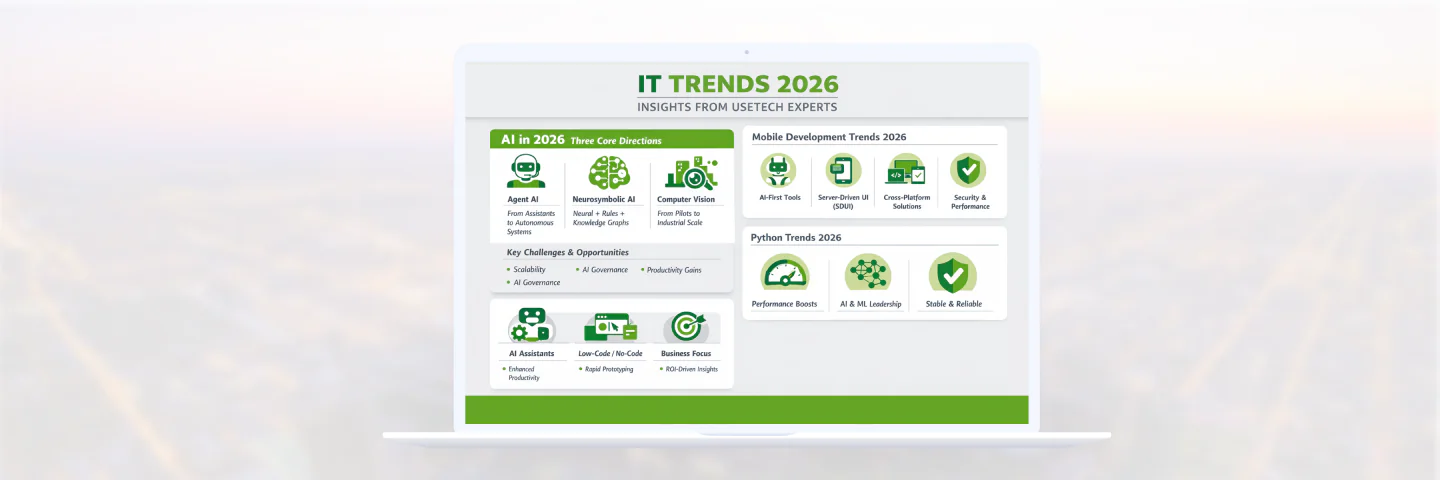
IT Trends 2026: Insights from Usetech Experts
As we approach 2026, the IT landscape continues to evolve at an unprecedented pace. We asked Usetech experts to share their perspective on the key trends shaping the year ahead, and here’s a comprehensive look at what’s coming. From AI to mobile development, analytics, and Python, these trends are set to redefine how organizations operate, innovate, and stay competitive.
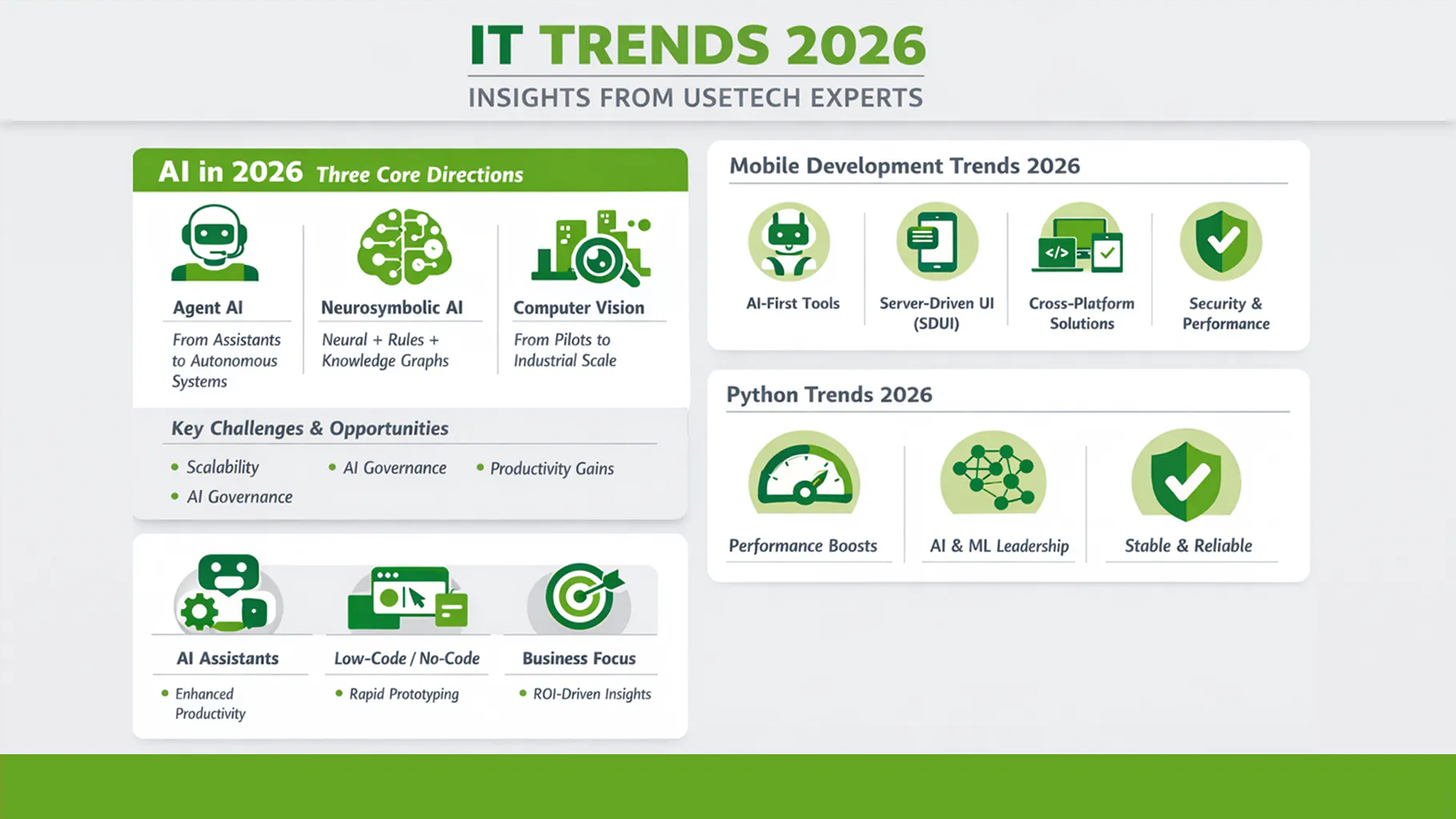
AI in 2026: Three Core Directions
Artificial Intelligence is taking an increasingly central role in organizational operations. The three major trends are Agent AI, Neurosymbolic Architectures, and Computer Vision as an industrial tool. Together, they are reshaping the technology landscape while creating new demands in governance, skills, and regulation.
Agent AI: From Chatbots to Autonomous Systems
Usetech experts predict a shift from passive assistants to systems capable of planning and executing action chains independently. Research shows that major enterprises are actively adopting agent platforms, where AI receives strategic objectives and determines the necessary steps autonomously.
These systems rely on advanced reasoning models capable of planning, logical inference, and self-correction, which requires significant computational resources and makes cloud infrastructure essential.
Two architectural paths:
- Cloud-based multi-agent platforms deploy as SaaS, enabling fast scaling and seamless integration with existing applications but increasing dependency on external providers.
- Managed on-premise agents combine neural components with deterministic workflows, offering full control and logging. They are used in critical infrastructure where autonomy is regulated and human oversight is mandatory.
Both approaches highlight the growing awareness of AI governance in high-risk areas.
Neurosymbolic AI: Structured Knowledge Returns
Amid the LLM boom, classical AI approaches are regaining attention. Purely statistical models can hallucinate, lack explainability, and fail to guarantee logical consistency — critical in medicine, law, and industry.
The 2026 architectural insight: Neural + Rules + Knowledge.
A typical system combines:
- Neural layer: Processes unstructured data (text, images, signals), extracting entities and hypotheses.
- Symbolic layer: Applies rules, ontologies, and logic to ensure consistency with physical laws, regulations, and internal data.
- Knowledge graphs: Represent information as networks of objects and relationships, serving as a persistent source of truth even when models evolve.
Example application: In energy management, a knowledge graph maps equipment, parameters, and operating modes, while the neural layer updates data and detects anomalies.
Computer Vision: From Pilots to Industrial Scale
By 2026, Computer Vision is one of the most mature AI fields. The focus is economic: where ROI justifies adoption and how risks are managed. Early adoption targets high-labor-cost sectors such as manufacturing (quality control), logistics, healthcare (diagnostics), and infrastructure monitoring.
Integrated Systems — 2026 Architecture:
- Perception layer: Computer vision, sensors, textual inputs.
- Understanding layer: Neural models + RAG connect data to domain knowledge.
- Reasoning layer: Neurosymbolic components apply rules, ensuring consistency and explainability.
- Action layer: Agents plan and execute, aligned with regulations and human oversight.
Cloud solutions scale quickly, while on-premise deployments offer full control and compliance. Choice depends on organizational goals, regulations, and strategy.
Key Challenges and Opportunities:
- Technical: Scaling reasoning models, integrating neural and symbolic components, and ensuring high-quality training data.
- Management: Regulatory compliance, upskilling staff, and model error governance.
- Opportunities: Dramatically increased productivity in high-labor-cost sectors, new business models for AI integration, and long-term competitive advantage for organizations investing in structured knowledge.
Mobile Development Trends 2026
The world of mobile development is entering a more foundational phase, with new architectures, business strategies, and tools emerging. Key trends include:
- AI-First: AI assistants like Cline, RooCode, Cursor, and Windsurf integrate with IDEs, supporting multiple LLMs and enabling step-by-step or fully automated workflows. AI supplements rather than replaces developers, helping with testing, UI conversion, and task decomposition.
- Server-Driven UI (SDUI): Minimal release cycles remain critical, especially for iOS apps. Companies are exploring hybrid architectures, AI integration, and cross-platform solutions while optimizing SDUI performance.
- Cross-Platform Development: Flutter, Kotlin Multiplatform, React Native dominate. Cross-platform development now spans desktops, web, IoT, embedded devices, and microcontrollers. Native SDKs continue to evolve for memory management, flexibility, and performance.
- Security, Performance, and Accessibility: AI-driven development and multi-device targets make code security, user privacy, energy efficiency, and usability paramount.
- Skill Convergence: Developers increasingly combine coding with testing automation, infrastructure management, and AI-assisted workflows.
Analytics Trends 2026
- AI Assistants as Team Members: Analysts shift focus from execution to expertise. AI handles routine documentation, user stories, and summaries, freeing analysts for hypothesis testing, architectural design, and stakeholder communication.
- Low-Code/No-Code for Analysts: Analysts can independently build functional prototypes, dashboards, or voice bots, accelerating time-to-market and turning analysts into creators.
- Business Outcome Focus: Analysts adopt a business-oriented mindset, prioritizing ROI, customer impact, and cost-efficiency over technical details.
Python Trends 2026
Python remains a versatile and popular language. Key developments include:
- Performance Improvements: Free-threaded mode and concurrent interpreters allow multiple interpreters in a single process, addressing longstanding GIL limitations.
- AI Dominance: Python continues to lead in ML/AI, powering generative models, LLM agents, and automation tools.
- Stability and Reliability: 2026 will be a year of consolidation, strengthening existing Python solutions across domains.
Conclusion
2026 marks the transition of AI from experimental projects to core operational infrastructure. Agent AI, neurosymbolic architectures, and computer vision converge to create a new technological stack, demanding new skills, governance approaches, and risk awareness. Mobile development, analytics, and Python continue to evolve in parallel, offering both challenges and immense opportunities.
Take Action Now: Organizations and professionals who embrace these trends early — investing in AI integration, hybrid architectures, cross-platform mobile development, and business-focused analytics — will secure a lasting competitive edge in 2026 and beyond.