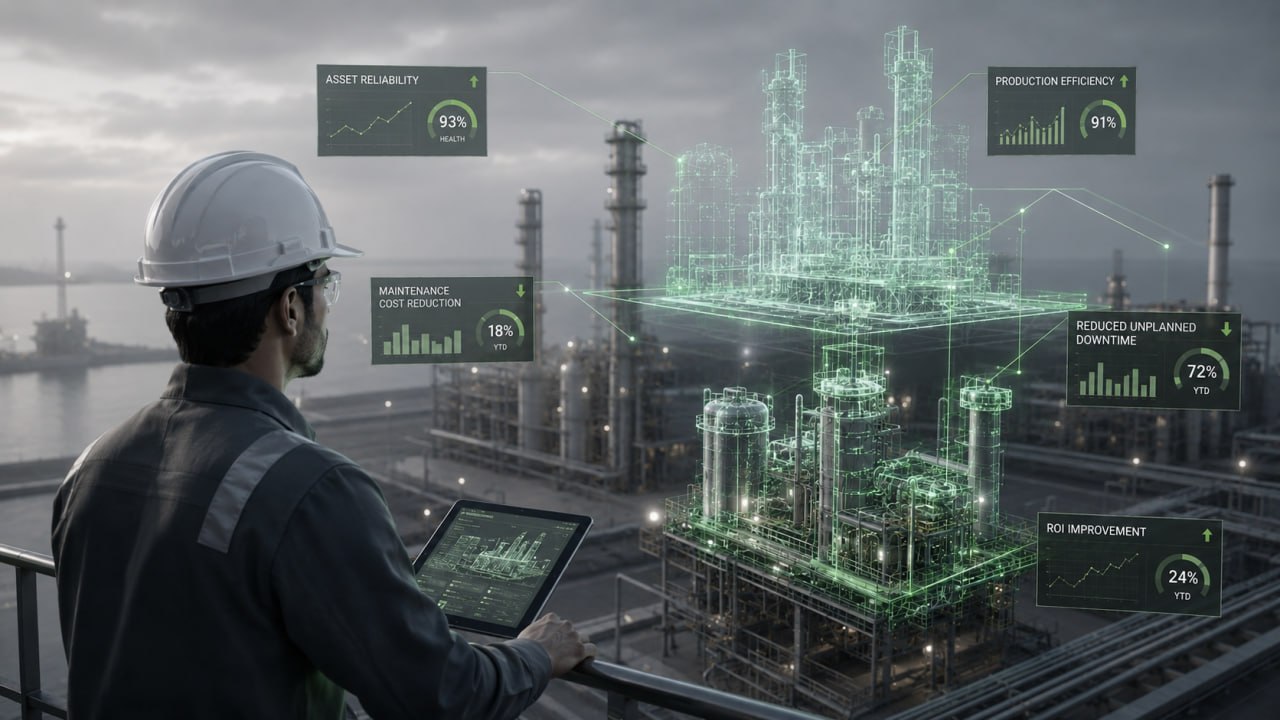
An aggregated analysis based on data from ADNOC, Saudi Aramco, IntelEvoResearch, Dataintelo, and Usetech’s operational experience building data infrastructure for energy sector clients across the Gulf.
We covered the strategic case for digital twins in GCC oil and gas in an earlier piece. This guide goes deeper — into implementation, ROI architecture, and the traps that most operators don’t see coming.
Digital twins in oil & gas GCC are no longer a pilot-phase technology. A billion dollars is a specific number — not a projection, not a scenario.
ADNOC’s Panorama Digital Command Center has generated over $1 billion in business value since its completion in 2018, aggregating real-time data across 14 subsidiary and joint venture companies covering 65 operating sites. Saudi Aramco’s AI and digital technology program — built on the same foundation of digital twins and data integration — doubled its annual technology value realization from $2 billion in 2023 to $4 billion in 2024.
These are not R&D experiments. They are production systems, running at scale, generating documented financial returns in the hardest operating environment in the world.
And yet, across the broader GCC energy sector, most operators are still approaching digital twins as a future initiative rather than a present-tense deployment. In 2025, more than 60% of operators cited talent gaps as a primary barrier to digital twin deployment, while 48% identified integration complexity with legacy systems as a significant challenge. The technology is proven. The ROI is documented. The gap is implementation.
This guide examines what successful digital twins in oil & gas GCC deployments actually look like, what the implementation pitfalls are, and how to build the data infrastructure that makes the difference between a successful pilot and a facility-wide capability.
What a Digital Twin Actually Does in Oil & Gas GCC
A digital twin is a continuously updated virtual replica of a physical asset, process, or facility, synchronized with real-time operational data. In the context of digital twins in oil & gas GCC operations, this definition has specific technical implications that distinguish a real implementation from a sophisticated dashboard.
The key word is continuously. A static 3D model of a refinery is not a digital twin. A process simulation that runs periodically is not a digital twin. A digital twin is live: it reflects the current state of the physical asset at every moment, and uses that real-time state to generate predictions, simulate scenarios, and recommend actions.
GCC oil and gas operators deploy digital twins across three distinct categories, each with different data requirements, different technical complexity, and different ROI profiles.
Asset digital twins model individual pieces of equipment — a compressor, a pump, a heat exchanger — monitoring condition in real time and predicting failure before it occurs. This is the most common entry point for digital twins in oil & gas GCC projects, and the fastest path to measurable ROI. ADNOC’s predictive maintenance platform, built on digital twin infrastructure, is expected to deliver maintenance savings of up to 20% across critical rotating equipment. For a broader look at predictive maintenance economics in the region, see our analysis of predictive maintenance costs and ROI in GCC manufacturing.
Process digital twins model entire production processes — a gas sweetening unit, a crude distillation column, a pipeline segment — enabling operators to optimize operating parameters continuously rather than relying on fixed setpoints. Saudi Aramco developed an online advisory process digital twin for a gas sweetening system that continuously optimizes operating conditions. These technologies have helped Aramco maintain a stable extraction and processing cost of $3 per barrel for two decades — an extraordinary benchmark by any measure.
Enterprise digital twins link multiple asset and process twins into a unified operational picture — what ADNOC calls its Panorama model. ADNOC’s Panorama aggregates real-time information from over 100,000 data tags across 16 operating companies, enabling value chain optimization decisions that no single-asset view could support. The Panorama Digital Command Center enables savings of between $60 million and $100 million annually through optimized operations, according to AVEVA’s implementation documentation.
Usetech perspective: In our experience, the most common mistake operators make when approaching digital twins in oil & gas GCC environments is choosing scope based on ambition rather than data readiness. Enterprise-level twins are compelling — and the right long-term destination — but they require a data infrastructure foundation that most facilities have not yet built. Starting with a high-criticality asset twin, proving the ROI, and using that project to build the data pipeline architecture for broader deployment is consistently the more successful sequencing.
The GCC Landscape: Who Is Building Digital Twins in Oil & Gas
The three national oil companies of the GCC have taken structurally different approaches to digital twin deployment in oil & gas — reflecting their different scales, operating environments, and strategic priorities.
Saudi Aramco: The Full-Stack Integrator
Saudi Aramco’s approach to digital twins in oil & gas is the most vertically integrated in the region. The company built its own digital infrastructure layer — the OSPAS hydrocarbon supply chain management system, boasting 99% reliability — rather than depending entirely on third-party platforms.
In December 2024, Honeywell signed a partnership with Saudi Aramco to deploy Honeywell Forge digital twins across 8 upstream mega-fields, valued at $340 million over five years — not as a greenfield deployment, but as a layer built on top of existing digital infrastructure that Aramco had spent years developing.
ADNOC: The Value Chain Optimizer
ADNOC’s defining characteristic is the enterprise scope of its digital twin ambition in oil & gas operations. Rather than starting with individual assets and scaling up, ADNOC built its Panorama Digital Command Center as an enterprise-first platform and used it to drive optimization decisions at the system level.
ADNOC’s AI program generated $500 million in added value in 2023 alone from internal digital operations — before the company pivoted toward becoming an external AI infrastructure provider in 2025. The internal digital twin capability was the foundation that made that pivot credible.
QatarEnergy: The Selective Deployer
QatarEnergy has taken a more targeted approach, deploying digital twins in specific high-value oil & gas contexts — LNG process optimization, offshore asset management — rather than building enterprise-wide infrastructure. This reflects Qatar’s relatively smaller operational footprint and its preference for deep capability in priority areas over broad coverage.
Kuwait Oil Company is investing $800 million in a five-year digital transformation plan that includes digital twins as a core component, while BAPCO in Bahrain is integrating AI and digital twin technology to boost refinery efficiency and reduce carbon emissions.
The ROI Architecture: Where Digital Twins in Oil & Gas GCC Generate Value
Understanding where digital twin ROI originates is essential for building a credible business case — and for avoiding the trap of measuring the wrong things.
Unplanned downtime reduction is the most immediate ROI driver. Early adopters of digital twins in oil and gas are seeing 15–20% reduction in unplanned downtime. For a midstream facility where unplanned outages cost over £100,000 per hour in lost production, even a 15% reduction represents a payback period measurable in months, not years.
Process optimization delivers value more gradually but at larger scale. A process digital twin that continuously optimizes operating parameters — reducing energy consumption, improving yield, minimizing off-spec product — generates savings that compound across the operational life of the facility.
CAPEX optimization is the ROI category most often overlooked in deployment business cases. A digital twin that enables simulation of capital investment scenarios before a dollar of construction capital is committed can generate value that dwarfs operational savings. For major offshore or downstream capital projects in the GCC, this is often the most compelling board-level ROI argument.
ESG and regulatory compliance is becoming an increasingly significant value driver. GCC environmental regulations are compelling operators to adopt continuous digital monitoring solutions, with digital twins serving as the backbone of real-time emissions tracking. The sovereign AI and data governance framework shaping this regulatory environment is analyzed in detail in our piece on sovereign AI architecture in MENA.
Usetech perspective: The business cases we build with GCC energy sector clients always start with unplanned downtime reduction — it is the most defensible number and the fastest path to ROI demonstration. But the cases that get approved at board level layer process optimization and CAPEX avoidance on top of the maintenance story. A business case showing $5 million in annual maintenance savings is a technology project. One showing $5 million in maintenance savings plus $20 million in CAPEX optimization for an upcoming expansion is a strategic investment.
The 3 Implementation Traps for Digital Twins in Oil & Gas GCC
The gap between a digital twin proof of concept and a production-grade deployment is where most implementations fail. Three structural traps account for the majority of failures.
Trap 1: Treating Data Quality as Someone Else’s Problem
Every digital twin is only as good as the data that feeds it. If sensor data is inaccurate or delayed, a digital twin can produce misleading predictions — and continuous calibration and regular validation are necessary to maintain accuracy. Many GCC facilities discover that their sensor networks have significant coverage gaps, their historian data contains inconsistencies accumulated over years of shift handovers, and their SCADA systems were configured for control rather than analytics.
Trap 2: The Integration Underestimate
Integration complexity in multi-vendor, multi-decade technology environments remains a significant challenge, with large integrated operators often running dozens of disparate SCADA, DCS, historian, and ERP systems that must all be connected. The integration work is consistently the largest source of schedule overruns — not because it is technically impossible, but because its scope is underestimated at project initiation.
Trap 3: Vendor Lock-In at the Platform Layer
Vendor lock-in concerns, as operators commit to large, multi-year platform contracts with a single digital twin software vendor, represent a strategic risk leading some operators to prefer open, modular architectures. The operators who manage this risk most successfully treat the data layer and the analytics layer as separable concerns — the data pipeline owned by the operator, the analytics platform replaceable without rebuilding the foundation.
“In oil and gas, the digital twin is only as smart as the data architecture underneath it. We’ve seen projects where significant investment went into the visualization layer — impressive dashboards, sophisticated 3D models — while the underlying data pipeline was fragile, poorly documented, and dependent on manual intervention to stay current. Those projects don’t fail dramatically. They degrade quietly: the twin drifts out of sync with physical reality, the predictions become less reliable, and the operations team stops trusting it. Building the data foundation correctly — sensor coverage, data quality, integration architecture — is less visible than the twin itself, but it determines whether the investment holds its value over a 10-year horizon.”
— Ilya Smirnov, Head of AI/ML at Usetech
4-Phase Deployment Framework for Digital Twins in Oil & Gas GCC
For GCC energy sector operators, the following four-phase framework reflects sequencing that consistently produces successful digital twin outcomes.
Phase 1 — Data Infrastructure Audit (4–8 weeks). Before selecting a digital twin platform, map the current state of operational data: which assets are instrumented, at what frequency, in what format, and with what data quality. This audit determines the realistic scope and timeline for everything that follows. We covered the foundational importance of this step in our earlier overview of digital twins in GCC oil & gas operations.
Phase 2 — High-Criticality Asset Twin (3–6 months). Deploy an asset-level digital twin on the equipment with the highest combination of failure consequence and data readiness — typically a critical compressor, pump train, or heat exchanger. Use this deployment to prove the ROI and validate the data pipeline architecture.
Phase 3 — Process-Level Extension (6–12 months). Extend the digital twin from individual assets to the production process they are embedded in. This phase introduces process optimization as a value driver alongside predictive maintenance, and requires connecting the asset twin to process historians, laboratory data, and operational logs.
Phase 4 — Enterprise Integration (12–24 months). Connect process-level twins into an enterprise operational picture, enabling value chain optimization decisions. This is the ADNOC Panorama model — and it requires the data infrastructure foundation built in phases 1 through 3 to function correctly.
Market Momentum: Digital Twins in Oil & Gas GCC in 2026
The global oil and gas digital twin market was valued at $4.13 billion in 2024 and is projected to reach $18.6 billion by 2034, growing at a CAGR of 16.3%. Cloud deployment captured 53.8% of the market in 2025, with AWS, Microsoft Azure, and Google Cloud all launching oil and gas digital twin accelerators.
Digital twin adoption in oil and gas has reached 50% of operators globally by 2026. Operators who have not yet deployed are no longer early adopters making a strategic bet — they are late movers in a market where the ROI case is documented and the competitive disadvantage of inaction is compounding.
The Middle East and Africa region holds approximately 14.5% of the global digital twin in oil and gas market, driven by GCC sovereign energy programs. Saudi Aramco and ADNOC maintain on-premise twin infrastructure within secure data centers — the sovereign data residency model the region’s regulatory environment increasingly requires.
FAQ: Digital Twins in Oil & Gas GCC
A digital twin in oil and gas is a continuously updated virtual replica of a physical asset, process, or facility — synchronized with real-time sensor data and used to predict failures, optimize operations, and simulate capital investment scenarios before committing resources.
Documented results include: ADNOC Panorama generating over $1 billion in business value and $60–100 million in annual operational savings; Saudi Aramco doubling technology value realization from $2 billion to $4 billion between 2023 and 2024; and industry-wide early adopters reporting 15–20% reduction in unplanned downtime.
Saudi Aramco (Smart Oilfield program, Honeywell Forge partnership across 8 upstream mega-fields), ADNOC (Panorama Digital Command Center covering 16 operating companies), QatarEnergy (LNG process and offshore asset management), Kuwait Oil Company (five-year $800 million digital transformation), and BAPCO Bahrain (refinery efficiency and emissions reduction).
Three structural challenges dominate: data quality gaps in legacy sensor networks and historian systems; integration complexity across multi-vendor, multi-decade SCADA, DCS, and ERP environments; and vendor lock-in risk from large multi-year platform commitments.
Asset-level digital twins typically show measurable ROI within 6–12 months of deployment. Process-level twins generate compounding savings over 12–24 months. Enterprise-level twins (the ADNOC Panorama model) require 24+ months to reach full value but deliver the largest long-term returns.
Usetech Risk Digital Twin is a purpose-built solution for energy asset management, connecting operational data, ML-based failure prediction, and risk visualization in a single platform — designed specifically for the data residency and integration requirements of GCC oil & gas operators.
Ready to assess your data infrastructure readiness for digital twin deployment? Talk to our team about a no-commitment data readiness assessment for your facility.
Methodology note: This analysis aggregates data from IntelEvoResearch Oil and Gas Digital Twin Market Report (2024–2034), Dataintelo Digital Twin in Oil and Gas Market Report, ADNOC official publications and CIO coverage, Astute Analytica market research (November 2025), Saudi Aramco technology reporting via EnkiAI analysis, Grand View Research Digital Oilfield Market data, Ken Research Saudi Arabia digital twins market analysis, and Usetech’s operational experience with data infrastructure and ML deployments in the GCC energy sector. Usetech perspectives reflect professional judgment based on direct implementation experience and should be read as informed operational assessment, not primary research. The Ilya Smirnov quote reflects the Usetech team’s distillation of operational experience across multiple energy sector deployments. All figures are current as of May 2026.