
A large government infrastructure organisation needed to reduce overload and improve data centre service quality without expanding hardware capacity. Usetech implemented and fine-tuned Octopus within the customer’s internal environment to improve workload distribution.
Key results
- 40% lower resource deficit
- 30% higher infrastructure efficiency
- More than 86% of virtual machines removed from high-risk zones
Client and infrastructure
The client is a large government infrastructure organisation. The project centred on the quality and stability of its data centre services, with high availability as a core operating requirement.
| Client | Large government infrastructure organisation |
| Industry | Government |
| Solution | Octopus |
| Deployment environment | Customer’s internal infrastructure |
| Deployment scope | 494 virtual machines, 38 physical servers and 69 storage systems |
Business challenge
The project needed to address performance spikes, infrastructure overload and resource deficits while ensuring high availability and operational stability. The organisation wanted to improve service quality and efficiency using its existing hardware.
That constraint made workload distribution central to the project. The team needed to reduce pressure on the infrastructure by using the available resources more effectively, while preserving the availability required by the organisation.
Implementation and platform approach
Usetech deployed and fine-tuned Octopus within the customer’s internal environment. The work focused on improving workload distribution across the infrastructure in scope.
Octopus is an on-premises platform for managing and rebalancing virtual infrastructure. It integrates with existing hypervisors and monitoring tools, collects resource data and analyses demand without installing agents inside workloads. Its on-premises deployment model keeps data and control within the organisation.
How the platform works
Collection. CPU, memory, storage and network data provide a view of resource consumption across the connected infrastructure.
Analysis. AI-based load prediction, peak forecasting and bottleneck detection help identify where resource pressure is likely to occur.
Redistribution. Octopus can redistribute virtual machines between hosts, reduce local overload and consolidate workloads to release underused server capacity.
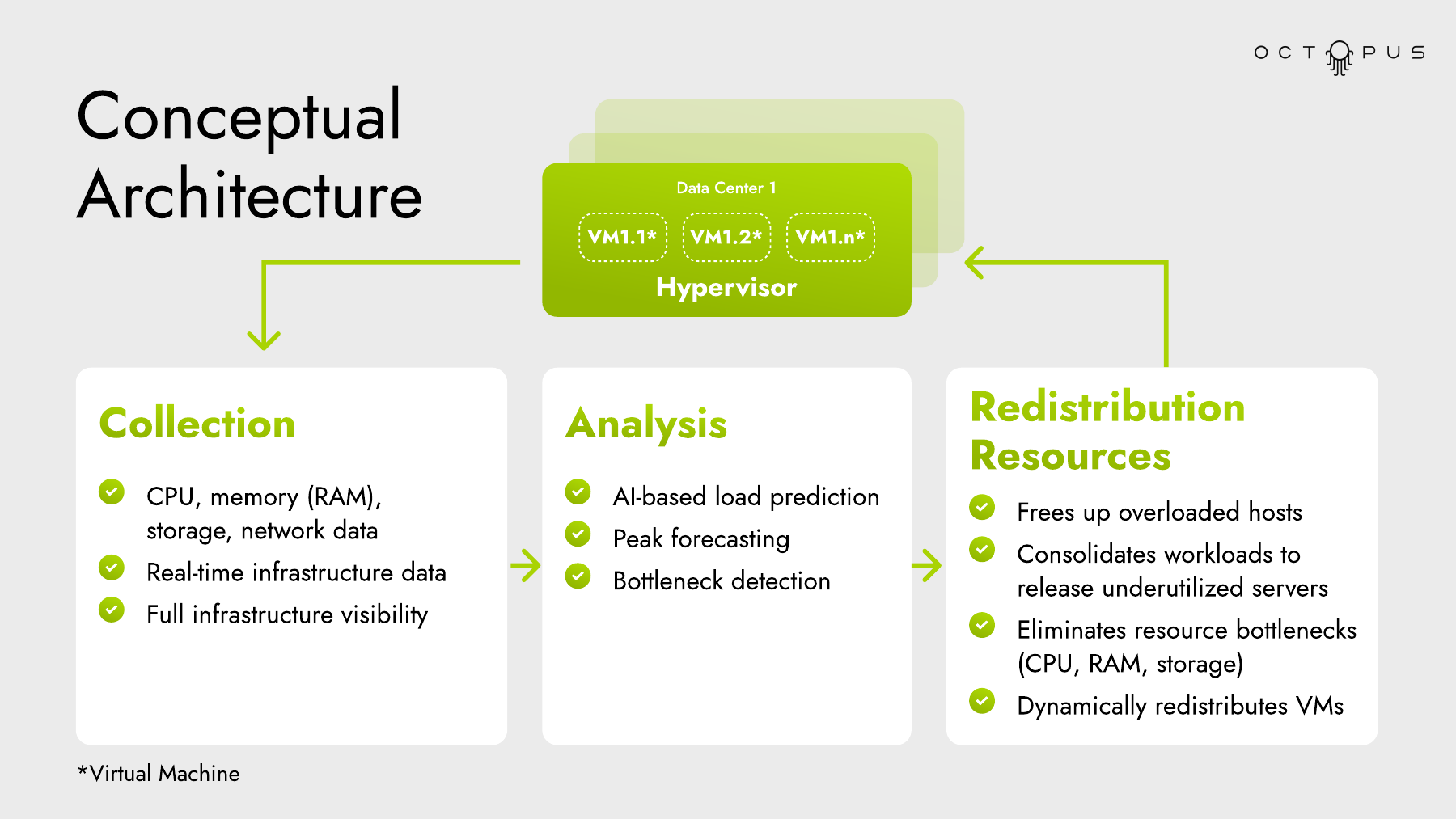
Conceptual product architecture from the Octopus presentation.
A controlled approach to rollout
Octopus can be evaluated through a capacity assessment to establish baseline utilisation and a controlled pilot within a limited production scope, with success metrics agreed in advance. The platform also supports supervised automation with policies and rollback, allowing teams to retain control over changes.
Project results
Improved workload distribution reduced the resource deficit by 40%. More than 86% of virtual machines were removed from high-risk zones. Infrastructure efficiency increased by 30%, and the organisation delayed hardware expansion.
The operational change was better use of the environment already in place. For the organisation, postponing expansion connected infrastructure optimisation with the timing of its next hardware investment.
These figures describe the reported outcome of this deployment. The effect in another environment will depend on its workloads, resource constraints and operating requirements.
Discuss your capacity challenges
Talk to our team about resource pressure, workload distribution and the performance of your current infrastructure.
An initial conversation can help define the scope of a capacity assessment and the outcomes to evaluate in a pilot.