Smart Manufacturing Starts When Growth Gets Harder to Control
Explore how smart manufacturing helps Saudi and UAE factories connect systems, use real-time data, AI, and digital twins to improve control and scale.
Manufacturing usually does not become difficult because demand is growing.
It becomes difficult because growth reveals everything the operating model was already struggling to hold together.
Visibility weakens first. Data arrives late. Quality issues surface after the fact. Decisions slow down just as production speed increases. Safety risks grow. Downtime becomes more expensive. What once looked manageable at one scale becomes structurally expensive at another.
That is the real starting point for smart manufacturing.
What Smart Manufacturing Actually Means
It is not a decorative label for factories, and it is not only about putting AI into production. At its core, smart manufacturing is the disciplined use of real-time data, connected systems, predictive tools, and operational control to make manufacturing more stable as it grows more complex.
Building on Top of What Already Exists
The strongest programmes usually do not begin with replacement.
They begin by building a layered environment on top of what already exists:
- a stronger integration backbone
- a usable operational data layer
- AI and computer vision for real-time monitoring
- digital twin logic for risk and optimization
- infrastructure that can actually support growing demand
- workforce adoption so new tools do not remain foreign to the operating culture
This matters because most manufacturers are not starting from zero. They are working through mixed environments, inherited systems, and live production constraints. A credible smart manufacturing programme has to improve control without asking the business to stop running while transformation happens around it.
From Abstract Digitalization to Operating Control
That is why the best current manufacturing story is not “full digitalization” in the abstract.
It is a more specific story:
- How do we detect faster?
- How do we reduce manual dependency?
- How do we improve quality earlier in the process?
- How do we manage infrastructure better?
- How do we make production decisions with less lag and less guesswork?
Once those questions become central, smart manufacturing stops sounding like a future concept and starts looking like an operating model.
How Our Smart Manufacturing Portfolio Works
This is also the logic behind our Smart Manufacturing portfolio. It is a modular, end-to-end portfolio covering the critical capability layers required to build, scale, and operate Smart Manufacturing. It connects machines, processes, and systems into a unified data layer, transforms raw data into actionable insights in real time, and enables closed-loop decision-making that shifts operations from reactive to predictive and autonomous.
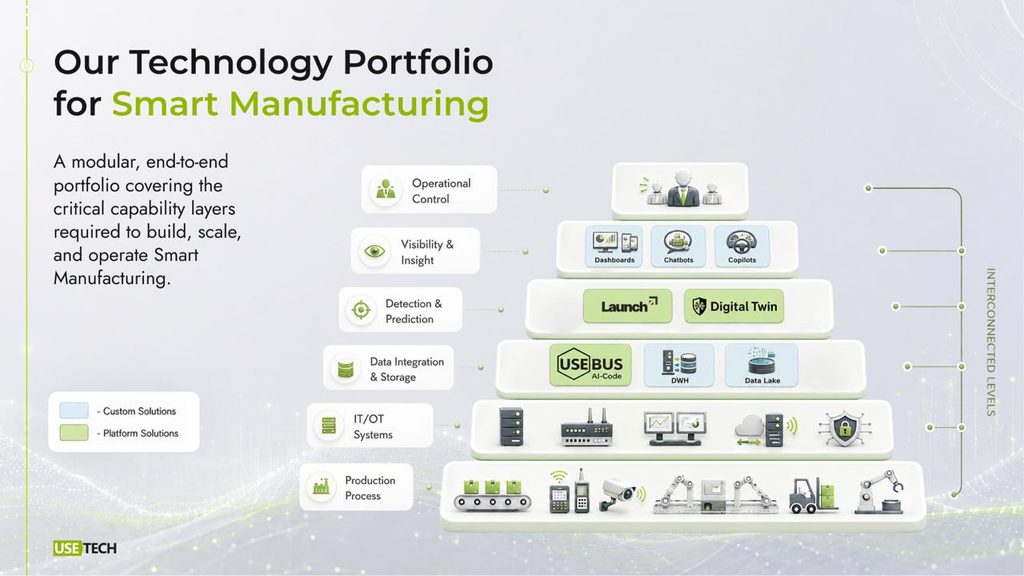
In practice, that means expanding on top of existing infrastructure rather than replacing it: a toolset extension that improves end-to-end visibility from shop floor to enterprise dashboards, with embedded AI, security by design, and closed-loop operations. The portfolio brings together connected capability layers including an integration backbone, AI/ML analytical platform, digital twin, and infrastructure optimization to support detection, prediction, control, and scalable growth.
Measurable Business Impact
4x faster integration delivery, up to 40% improvement in system reliability, up to 90% reduction in manual monitoring effort, 40% reduction in packaging errors, up to 10% reduction in Loss of Production Income (LPI), and 100% continuity of core systems.
Why This Matters Now in the Gulf
This is especially relevant in Saudi Arabia and the UAE, where industrial growth and modernization increasingly demand systems that can support higher volume, better predictability, and more disciplined execution.
The factories that move best into this next phase will not necessarily be the ones with the most visible technology stack.
They will be the ones with the strongest control logic underneath it.

Ph.D. in Mechanical Engineering and a Certified TOGAF 9 Enterprise Architect.