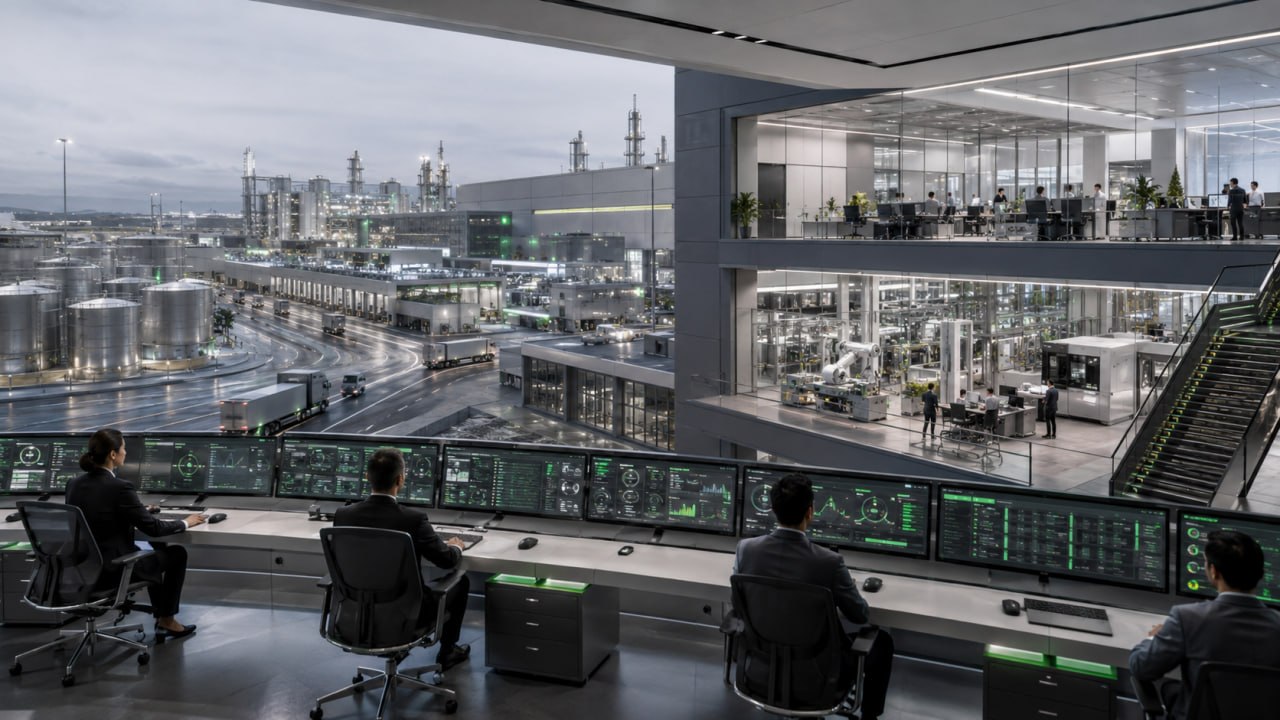
From experimentation to enterprise-scale AI
The GCC has become one of the most active regions for enterprise AI adoption. National programs such as Saudi Arabia’s Vision 2030 and the UAE National AI Strategy, combined with large-scale sovereign cloud investments, are accelerating digital transformation across both public and private sectors.
At the same time, organizations are under increasing pressure to improve operational efficiency, enhance customer experience, and unlock greater value from enterprise data.
Agentic AI addresses these priorities by shifting automation from isolated tasks to end-to-end workflow orchestration across enterprise systems.
This shift is significant: AI is moving from a tool for assistance to a system for execution.
However, scaling Agentic AI requires more than model capability. It demands a production-ready enterprise architecture that integrates data, systems, governance, and infrastructure into a unified operational environment.
According to Gartner, by 2026 more than 60% of enterprises adopting AI will implement formal governance frameworks that extend into operational AI systems and autonomous workflows.
Why production readiness matters
Most AI initiatives succeed in controlled environments but face challenges when moved into production.
The reason is structural: pilot environments typically operate with simplified data, limited integrations, and constrained governance. Production environments, by contrast, require AI systems to operate across ERP, CRM, HR, finance, and operational platforms in real time.
This is where the distinction between AI experimentation and AI capability becomes critical.
Deloitte’s Tech Trends 2026 highlights that organizations achieve greater value when AI is embedded into enterprise workflows rather than added on top of existing processes.
Five Foundations of Production-Ready Agentic AI
Production-scale Agentic AI is not defined by a single technology decision, but by five foundational capabilities.
1. Trusted enterprise data
Agentic AI depends on continuous access to accurate, governed, and connected data.
Unlike traditional analytics systems, AI agents require real-time context from multiple enterprise domains to execute tasks reliably.
In most enterprises, data is distributed across ERP systems, CRM platforms, document repositories, and operational databases. Without integration and semantic consistency, AI systems cannot reliably interpret or act on enterprise information.
Deloitte identifies data architecture as a primary constraint for scaling AI systems in production environments.
“AI agents amplify the quality of enterprise data. When data is trusted and connected, AI systems deliver consistent business value.”
What this means for GCC enterprises:
- Unified data governance across systems
- Real-time data availability
- Consistent metadata and semantics
- Clear ownership of enterprise data
- AI-ready data integration layers
2. Enterprise integration for autonomous workflows
Agentic AI operates across systems, not within them. This requires a shift from static integration models to dynamic orchestration, where AI agents coordinate multiple enterprise applications within a single workflow.
For example, an AI agent in procurement may interact with ERP systems, contract repositories, budget controls, and approval workflows simultaneously.
Deloitte notes that organizations create more value when they redesign workflows around AI capabilities rather than simply adding AI tools to existing systems.
Key requirements:
- API-first architecture
- Event-driven systems
- Workflow orchestration
- Secure identity management
- End-to-end observability
“Production-ready Agentic AI extends enterprise processes rather than layering intelligence on top of them.”
3. Governance as a core operational layer
As AI systems gain autonomy, governance becomes part of system design rather than an external control function. Agentic AI introduces new requirements for decision traceability, access control, and operational accountability.
Gartner projects that by 2026, most enterprises adopting AI will implement governance frameworks that extend beyond model oversight into operational AI systems.
Core governance capabilities:
- Defined autonomy boundaries
- Role-based access control
- Auditability of agent actions
- Real-time monitoring
- Human escalation paths
“Governance is what enables autonomy at scale — it is not a constraint, but an enabler of reliable AI operations.”
4. Infrastructure for continuous AI operations
Agentic AI introduces continuous reasoning and execution loops, requiring infrastructure beyond traditional enterprise systems.
These systems must support real-time inference, distributed orchestration, and persistent context handling.
IDC estimates that global enterprise AI infrastructure spending will exceed $200B by 2027, driven by demand for scalable AI workloads and agent-based systems.
Infrastructure requirements:
- Inference-optimized compute
- Low-latency data pipelines
- Orchestration frameworks
- Hybrid cloud environments
- Observability systems
“Production AI requires infrastructure that adapts continuously to autonomous workload patterns.”
5. Operational model transformation
Agentic AI changes how work is distributed between humans and systems.
Instead of automating isolated tasks, organizations must redesign end-to-end workflows and redefine accountability structures.
McKinsey reports that organizations achieving the highest AI value typically redesign workflows rather than layering automation on top of existing processes.
Organizational shifts include:
- Redesigned business processes
- Human-AI collaboration models
- New operational KPIs
- AI supervision roles
- Escalation frameworks
“The value of Agentic AI emerges when organizations redesign how work is executed, not just what is automated.”
Reference architecture for Agentic AI
Production-ready Agentic AI systems operate as a layered architecture:
Data layer
- Enterprise data sources
- Real-time pipelines
- Semantic models
Orchestration layer
- AI agents
- Planning and reasoning engines
- Tool execution frameworks
Integration layer
- APIs and event systems
- ERP/CRM connectivity
- Identity management
Governance layer
- Policy enforcement
- Audit logs
- Access control
Infrastructure layer
- Cloud/hybrid compute
- Inference systems
- Observability tools
Together, these layers form a continuous loop where AI systems retrieve context, plan actions, execute workflows, and learn from outcomes.
Key takeaways for GCC enterprises
Agentic AI adoption in the GCC is accelerating, but successful scaling depends on architecture rather than model capability.
Key insights:
- AI value depends on data and system connectivity
- Integration is a prerequisite for autonomous workflows
- Governance must be embedded in system design
- Infrastructure must support continuous AI execution
- Operational models must evolve alongside technology
As enterprises across Saudi Arabia, the UAE, and the wider MENA region accelerate digital transformation, these foundations will determine which AI programs move beyond pilots into production systems.
FAQ
Agentic AI refers to autonomous systems capable of planning and executing multi-step workflows across enterprise applications with minimal human intervention.
Challenges typically arise from data fragmentation, integration complexity, governance requirements, and infrastructure readiness rather than model performance.
Banking, energy, government, telecommunications, and healthcare are leading adoption due to strong digital transformation agendas.
Governance ensures transparency, access control, and compliance across autonomous AI workflows.
Pilot systems operate in controlled environments, while production systems require enterprise integration, scalability, and operational reliability.
Closing perspective
Agentic AI is becoming a defining capability of enterprise transformation in the GCC.
Organizations that succeed are not those that simply adopt AI early, but those that design systems capable of scaling AI safely, reliably, and in alignment with business and regulatory requirements.
In this context, Agentic AI represents not a standalone technology — but an architectural evolution of the enterprise itself.