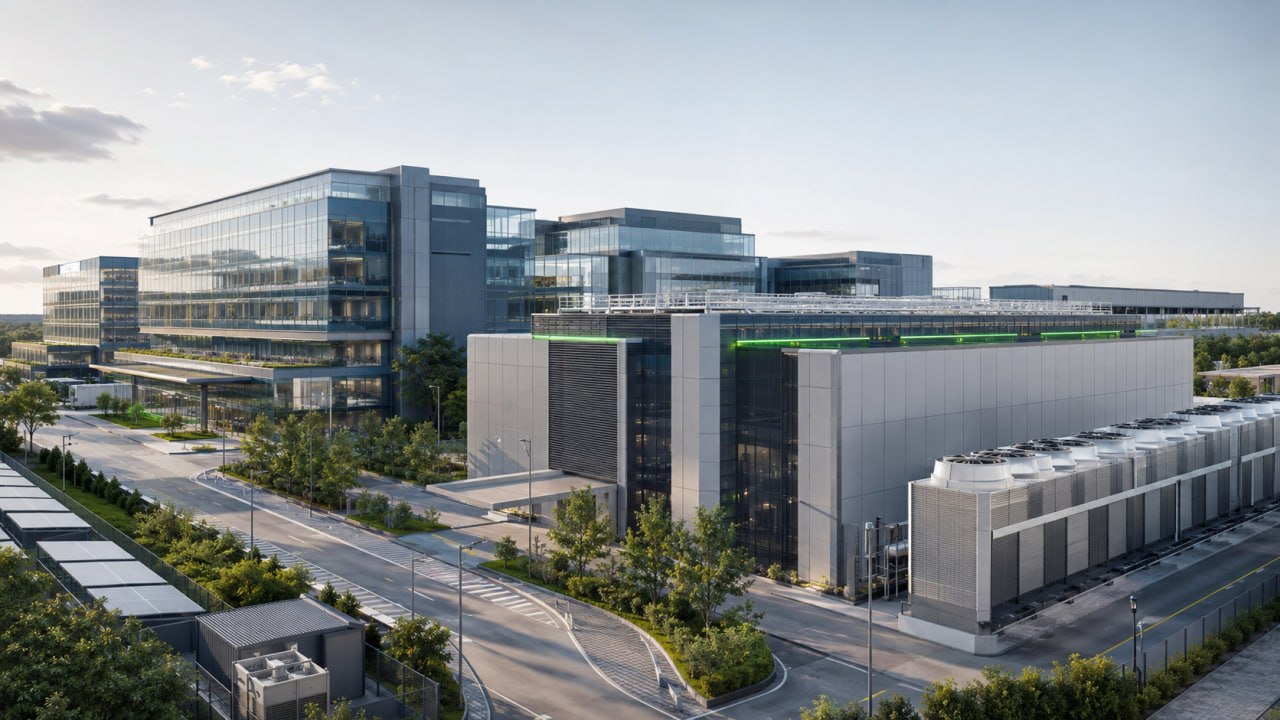
The GCC is in the middle of the largest compute infrastructure buildout in the region’s history. Saudi Arabia’s HUMAIN is targeting 1.9 gigawatts of AI data center capacity by 2030. The UAE’s G42 is building a 5-gigawatt campus — the largest AI facility outside the United States.
Globally, Goldman Sachs projects $7.6 trillion in cumulative AI infrastructure CapEx between 2026 and 2031. Against that backdrop, GPU supply chains are under pressure: H100-class chips now carry 36–52 week lead times from resellers, and hyperscalers have locked up most of NVIDIA’s Blackwell allocation through 2026 and into 2027.
For GCC enterprises that need compute to run AI workloads at production scale, the question of where compute comes from — and how to plan for it — has moved from the IT department to the boardroom.
“Three years ago, GCC boards asked whether to invest in AI. Two years ago, they asked what to build. Now the question is where the compute comes from and how to secure it. That is a supply chain question, and it belongs at the same level as any other strategic resource decision.”
What Is Happening in the Global GPU Market
The GPU supply situation in 2026 has two causes that reinforce each other.
Packaging capacity
H100 SXM5 nodes carry 36–52 week lead times because CoWoS packaging capacity at TSMC is fully allocated and HBM production from SK Hynix cannot keep pace with demand.
The constraint is not GPU die production. It is the memory and advanced packaging that surrounds the die.
TSMC announced capital expenditure for CoWoS expansion in 2024–2025, with meaningful new capacity expected in H2 2026 — but most of that new capacity will be absorbed by NVIDIA’s Rubin architecture rather than easing Blackwell supply.
Hyperscaler forward contracting
Microsoft, Google, Meta, and Amazon placed multi-billion-dollar forward orders for Blackwell GPUs in 2025, consuming most of NVIDIA’s available allocation capacity through end of 2026 and into 2027.
The five largest hyperscalers are projected to spend over $600 billion on infrastructure in 2026, with roughly 75% — approximately $450 billion — targeting AI infrastructure.
That concentration of demand has shifted enterprise buyers into a more constrained procurement environment than planning assumptions from 2023 or 2024 anticipated.
Goldman Sachs projects $765 billion in annual AI CapEx in 2026, growing to $1.6 trillion annually by 2031, with cumulative CapEx of approximately $7.6 trillion between 2026 and 2031.
When capital at that scale flows into a constrained supply chain, enterprises without advance commitments face a different procurement environment than they did two years ago.
What the GCC’s National AI Programs Are Building
The GCC’s response to this environment operates at sovereign scale. Saudi Arabia and the UAE are not competing for capacity alongside enterprise buyers — they are building capacity of their own, at a scale that changes the regional supply picture.
Saudi Arabia — HUMAIN
Saudi Arabia’s Public Investment Fund launched HUMAIN as its full AI value chain subsidiary.
HUMAIN and NVIDIA announced a strategic partnership to build AI factories in Saudi Arabia with projected capacity of up to 500 megawatts powered by several hundred thousand of NVIDIA’s most advanced GPUs over the next five years.
The broader HUMAIN strategy targets 1.9 gigawatts by 2030, expanding to 6 gigawatts by 2034.
HUMAIN has also signed a $10 billion deal with AMD to deploy 500 megawatts of AI compute over five years, and a partnership with Qualcomm for 200 megawatts of computing capacity starting in 2026.
Tareq Amin, CEO of HUMAIN, described the ambition: “What we want to do in 2026 is to build the capacity equivalent to what Saudi has built in the last 20 years, in one year.”
UAE — G42 and the Stargate Campus
G42 is building a 5-gigawatt AI data center campus — the largest AI facility outside the United States, utilizing NVIDIA’s Grace Blackwell GB300 systems.
Microsoft’s commitment to G42 spans 2023 through 2029: $1.5 billion in equity, more than $4.6 billion in data center capital expenditure, and $7.9 billion in further investment from 2026 through 2029, nearly quadrupling local data center computing capacity to the equivalent of 81,900 H100 chips.
The US Commerce Department approved chip exports to both G42 and HUMAIN in November 2025, allowing purchases equivalent to up to 35,000 NVIDIA GB300-class chips each, subject to security and reporting requirements.
Qatar — QAI
Qatar launched QAI, its national AI company backed by QIA, with a $20 billion AI infrastructure initiative covering high-performance data centers and platform investments.
The Qatar industrial automation and AI market reached $509 million in 2025 and is projected to grow to $944 million by 2034.
The GCC data center market is projected to grow from $3.48 billion in 2024 to $9.49 billion by 2030 at an 18.2% CAGR, with regional capacity tripling from 1 gigawatt in 2025 to 3.3 gigawatts by 2030.
What This Means for GCC Enterprises
The scale of HUMAIN, G42, and QAI sets the macro picture. It does not directly resolve the compute planning challenge for the broader enterprise sector — manufacturers, financial institutions, healthcare systems, logistics operators, and government-linked entities that need AI compute at production scale.
For these organizations, the GPU supply situation in 2026 has three practical consequences.
Planning horizons have extended
With 36–52 week lead times for physical hardware and reserved cloud capacity booked six or more months ahead, compute capacity decisions now need to run on a 12–18 month horizon rather than a standard annual budget cycle.
Organizations that plan compute on a calendar-year basis are misaligned with the procurement timelines the current market requires.
Both overprovisioning and underprovisioning carry significant financial consequences
The range of planning outcomes in AI infrastructure is wide. Meta underestimated GPU requirements by 400% in 2023, forcing emergency procurement of 50,000 H100s at premium prices, adding $800 million to their AI budget.
At the other end, a Fortune 500 financial institution overprovisioned by 300%, leaving $120 million in GPU infrastructure idle for two years.
The planning discipline required to navigate between these outcomes has changed significantly from what most organizations last applied.
Utilization visibility is the starting point
An organization that does not know its current GPU utilization rate — across all workloads, all environments, all cost centers — is working without a baseline.
McKinsey targets 65–75% average utilization as the planning baseline, with 20–30% buffer for spikes and growth.
Precise utilization data by workload type and environment is what makes a capacity decision defensible.
“The organizations we work with in the GCC that are furthest along on AI infrastructure planning share one characteristic: they know their current utilization numbers precisely, by workload type and by environment. Everything follows from that. Without it, a capacity decision is an estimate. With it, it is a plan.”
Three Decisions That Require Board-Level Input
1. Compute Sourcing: Build, Reserve, or Buy
The choice between owned infrastructure, cloud capacity, and reserved capacity has changed in financial and strategic character.
Commercial terms in 2026 are shifting from the provision of space and power to defined computational outputs — throughput or token generation under a service level agreement — with customer audit rights to verify performance metrics against the underlying GPU clusters.
Capacity reservation and take-or-pay compute offtake agreements are becoming standard contract structures, which means the financial commitment is now multi-year and carries delivery obligations on both sides.
For GCC enterprises operating under data sovereignty requirements — Saudi Arabia’s PDPL and the Cloud Computing Regulatory Framework mandate that certain data cannot leave the Kingdom — the sourcing decision also has a compliance dimension.
Compute that satisfies performance requirements may not satisfy data residency requirements. Aligning both is a design constraint that needs to be established before any sourcing arrangement is finalized.
2. Software Efficiency and Utilization Planning
Software optimization trajectories deliver 20–30% annual efficiency gains through compiler improvements alone. Quantization and pruning compress models 4–10 times with minimal accuracy loss.
For a GCC enterprise making a multi-year infrastructure commitment, the efficiency of the software stack running on that hardware is as financially significant as the hardware cost itself.
Capacity planning that accounts for software efficiency gains produces a more accurate picture of what hardware is actually needed over the commitment period.
3. Refresh Cycle and Capital Planning
AI-optimized data center facilities face a different trajectory than traditional cloud infrastructure, with future requirements bearing little resemblance even to AI-optimized facilities built in the last two years.
An accelerator purchased at $50,000 and depreciated over five years carries $10,000 per year in depreciation.
If a newer generation delivers dramatically better performance per dollar before the depreciation schedule expires, the organization continues carrying the cost of an asset whose economic contribution has changed.
Goldman Sachs identifies this dynamic as a structural consideration for the economics of the AI ecosystem. For GCC enterprises, the capital commitment decision and the refresh cycle assumption need to be evaluated together.
Key Metrics: GCC AI Compute Infrastructure (2025–2026)
| Indicator | Data | Source |
| HUMAIN target capacity (2030) | 1.9 GW | Multiple sources, 2025–2026 |
| HUMAIN expanded target (2034) | 6 GW | MEXC / Reuters, 2025 |
| HUMAIN-NVIDIA GPU commitment | Several hundred thousand GPUs / 500 MW over 5 years | NVIDIA Newsroom, 2025 |
| HUMAIN-AMD deal | $10 billion / 500 MW over 5 years | Fortune, 2025 |
| UAE G42 campus target | 5 GW | Data Center Dynamics, 2026 |
| Microsoft UAE investment (2023–2029) | $15.2 billion | Introl, 2026 |
| Qatar QAI infrastructure initiative | $20 billion | Multiple sources, 2025 |
| GCC data center market (2024) | $3.48 billion | Introl, 2026 |
| Projected GCC data center market (2030) | $9.49 billion (18.2% CAGR) | Introl, 2026 |
| GCC regional data center capacity (2025 → 2030) | 1 GW → 3.3 GW | Introl, 2026 |
| Global AI CapEx (2026 annual) | $765 billion | Goldman Sachs, 2026 |
| Cumulative global AI CapEx (2026–2031) | $7.6 trillion | Goldman Sachs, 2026 |
| H100-class GPU lead times (resellers) | 36–52 weeks | Spheron, 2026 |
| Top 5 hyperscaler AI infrastructure spend (2026) | $600+ billion | Accuris, 2026 |
| Target GPU utilization rate | 65–75% average | McKinsey / Introl, 2026 |
What This Means for GCC Technology and Operations Leaders
Establish utilization as a baseline before any capacity decision
Capacity commitments grounded in precise utilization data — by workload type and by environment — produce more accurate plans than those based on top-down estimates.
The utilization audit is the first step, not a parallel activity.
Extend planning horizons to 12–18 months
Standard annual budget cycles are misaligned with 36–52 week GPU lead times and cloud capacity reservation windows of six months or more.
Compute planning that runs on a calendar-year basis is behind the procurement timeline the current market requires.
Establish data sovereignty requirements before evaluating sourcing options
Saudi Arabia’s PDPL and data residency requirements under the Cloud Computing Regulatory Framework constrain where compute can be sourced and where data can be processed.
The compliance requirement is a filter that belongs at the start of the sourcing evaluation.
Include software efficiency improvement in the capacity plan
With 20–30% annual efficiency gains available through compiler improvements and 4–10x model compression through quantization, the software stack running on committed hardware is a financial variable.
A capacity plan that does not account for software efficiency trajectories will overestimate hardware requirements over a multi-year commitment.
Build refresh cycle assumptions into the capital model explicitly
AI accelerator generations are turning over faster than standard data center depreciation schedules assume.
A five-year depreciation cycle on infrastructure that may face significant performance-per-dollar shifts in two to three years requires an explicit assumption in the financial model.
“The GCC’s national AI programs — HUMAIN, G42, QAI — are building sovereign compute at gigawatt scale. For enterprises operating within that ecosystem, the question is how to position capacity planning and infrastructure decisions to align with that environment over the planning horizon ahead.”
FAQ: AI Compute Capacity Planning for GCC Enterprises
The financial exposure and strategic dependencies have grown to board-relevant scale. Multi-year capacity reservation contracts carry delivery risk.
Overprovisioning and underprovisioning both have seven-to-nine-figure financial consequences at enterprise scale. And in GCC jurisdictions with data sovereignty requirements, compute sourcing decisions carry regulatory obligations.
Together, these dimensions place compute capacity planning alongside other major capital allocation decisions.
Two reinforcing constraints. CoWoS packaging capacity at TSMC is fully allocated, limiting the volume of advanced AI chips that can be produced.
Hyperscalers also placed multi-billion-dollar forward orders for Blackwell GPUs in 2025, absorbing most of NVIDIA’s available allocation through end of 2026 and into 2027.
Organizations that did not commit compute earlier in the cycle are now working within a more constrained procurement window.
The national AI programs are building sovereign capacity intended to serve national AI strategies and potentially regional cloud services.
As that capacity comes online through 2026–2030, it will change the regional supply picture. Near-term availability for GCC enterprises remains tied to global GPU supply chains.
McKinsey’s framework targets 65–75% average utilization as the planning baseline, with 20–30% buffer for workload spikes and growth.
The right target varies by workload type — training runs have different utilization characteristics from inference workloads — which is why visibility by workload category is the necessary starting point for any capacity decision.
Saudi Arabia’s PDPL and the Cloud Computing Regulatory Framework require that certain categories of data remain within the Kingdom.
Compute arrangements that route regulated data through non-compliant jurisdictions create direct compliance exposure. The data residency requirement should be the first filter in any sourcing evaluation.
Market terms have shifted toward performance-based service levels — defined computational outputs such as throughput or token generation — rather than simple provision of space and power.
Enterprises should expect contracts to include guaranteed capacity metrics, chip refresh provisions as GPU generations turn over, clear allocation of deployment delay risk, and customer audit rights to verify performance commitments against the underlying hardware.
AI accelerator generations are turning over faster than traditional five-year data center depreciation schedules assume.
Financial models for AI infrastructure commitments should include explicit refresh cycle assumptions — when the current hardware generation is expected to face a significant performance-per-dollar shift, and what that means for the asset’s economic contribution over the depreciation period.
About Usetech
Usetech is a technology company focused on practical digital transformation for enterprise and strategic-sector environments across MENA.
Usetech helps organizations improve operational control, infrastructure efficiency, data integration, and decision speed through AI, data, and engineering solutions adapted to real regional conditions.
Core focus areas include AI and operational platforms, infrastructure optimization, data integration and enterprise connectivity, smart industry and digital operations, and strategic technology consulting for MENA growth environments.
If you’re interested in partnering with our team, would like to learn more about our services and products, or need a consultation, please get in touch by filling out the contact form.